
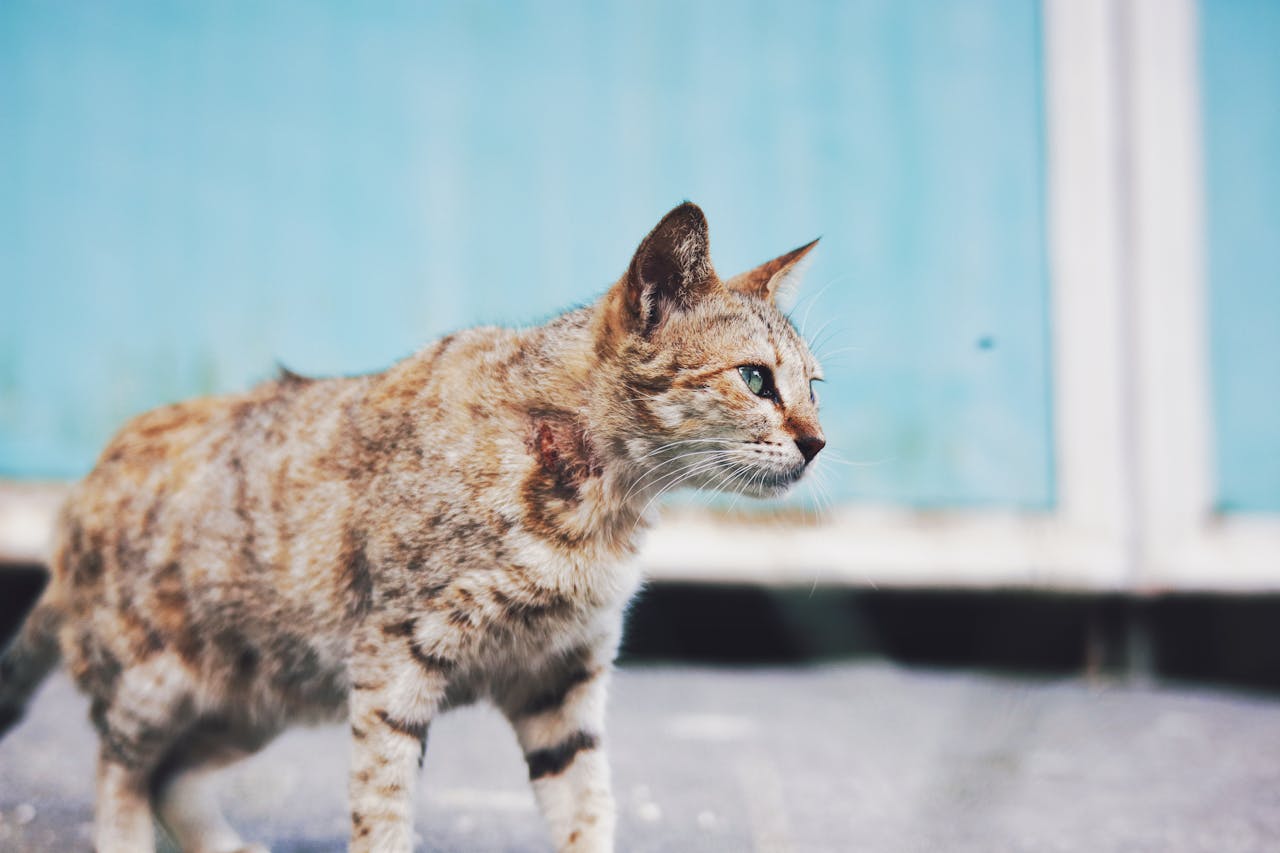
Has your cat come home with a scratch or bite from a neighborhood tussle?
Seeing your cat injured can be alarming, but don’t panic. Most cat fight wounds are minor and can heal with thorough cleaning and home remedies.
Knowing how to treat cat fight wounds at home can make all the difference, and it is a crucial skill for every cat parent.
In this guide, I’ll explain how to ensure your cat’s wound heals as quickly as possible. And because bacteria is rife in Thailand, I’ll also share what to do if your cat’s wound becomes infected.
Article content:
(Click any link to jump directly to the section)
What Do Cat Fight Wounds Look Like?
There are typically two types of wounds a cat may get from fighting with another cat – lacerations (superficial cuts) and puncture wounds (bite marks). Furthermore, if a puncture wound becomes infected, it can turn into an abscess.
All of these wounds look different, so let’s discuss each one in more detail.
Lacerations

Lacerations are superficial cuts, usually from a cat scratch. In cat fights, these wounds may appear as cuts or abrasions on the head, face, and ears.
Lacerations tear soft body tissue but typically don’t go any deeper. These may bleed a bit initially, but they heal quickly.
Even so, they can trap bacteria and become infected if not cleaned promptly. If this happens, the scratch might become swollen and red, and sores with or without pus might develop.
Puncture wounds
Puncture wounds are typically caused by a sharp, pointy object. In the context of a cat fight, this will likely be through a bite.
While puncture wounds don’t bleed much, they tear through to the deeper connective tissues.
The problem with puncture wounds in cats is that the superficial layer heals very quickly, so it can be difficult to spot them and clean them in time.
Cats have sharp teeth that can puncture the skin and introduce bacteria deep into the tissue. This can lead to infections and abscesses, which we’ll discuss next.
Cat Abscesses

If a puncture wound is not cleaned thoroughly before healing, it can trap bacteria and become an abscess.
An abscess is an infected wound in which a collection of pus forms under the skin and moves into the deeper tissues over time.
Abscesses damage the skin, deeper tissues, and, in some cases, the internal organs, depending on the location and size of the abscess.
Signs Your Cat Has A Fight Wound
A visible scratch or bite mark is the most prominent sign of a cat fight wound. But as mentioned, these are not always easy to spot.
While you may not see a wound, you might notice a small amount of blood or swelling, such as a raised bump.
Beyond a visible wound, there are some other, more subtle signs that your kitty might have a fight wound:
- Fever
- Lethargy
- Hiding or being less social than usual
- Limping (this is common when the wound is on a limb)
- Increased irritability or aggression
- Excessive grooming of one area of the body
- Flinching or crying out when you pick them up
How To Treat Cat Fight Wounds At Home
If you’re aware your cat has been in a fight, immediately check them over head to tail for wounds.
If you identify a wound, thoroughly clean the area using this simple 2-step procedure:
1. Clean the wound with saline solution
Soak a cotton pad with saline and gently squeeze the solution onto and into the wound. Wash your hands before and after!
If you are dealing with a puncture wound, use enough saline to flush the site and draw out bacteria from the deeper tissues.
2. Spray the wound with Colloidal Silver Spray

Colloidal Silver Spray is a topical treatment that utilizes nanotechnology to deliver active ingredients directly to the site of a wound.
Research has found it promotes accelerated and effective wound healing in humans and animals, including cats.
These nano-sized particles can penetrate the skin and tissues deeper, reaching areas that other topical treatments cannot.
The silver nanoparticles also have strong antibacterial, antifungal, and antiviral properties, helping to kill or inhibit bacteria growth.
You can get this pet topical treatment in the form of a spray, gel, or cream.
The Silver Grade Wound Spray for Pets is the easiest to use as you spray it directly on the wound.
However, many cats don’t like the sound of a spray bottle, so if this is the case with your kitty, use Silver Gel instead, which you can apply using a cotton bud.
Repeat this 2-step wound cleaning procedure at least twice a day for 5-7 days.
There is no need to cover the wound with a bandage. However, to prevent infection, keep your cat indoors until the wound is closed.
When To Go To A Vet
If your cat has a small and minor wound, such as a cut or bite mark, cleaning the wound yourself and monitoring for infection is fine.
However, if you notice any signs of infection, such as abscess formation, take your cat to the vet.
If you’ve ever had an abscess, you’ll know it can be painful; the same is true for cats.
Abscesses usually burst on their own eventually, but in doing so, they can leave a deep open wound susceptible to further infection.
So, if you notice an abscess, take your cat to the vet. Don’t wait for the abscess to burst, or worse, try to drain it yourself.
Cat Abscess Treatment

Vets treat abscesses in cats first by making a small incision to drain the pus and flush the site. This relieves the pressure and pain without leaving a big open wound.
They will then give you a course of antibiotics to treat any remaining infection. Antibiotics are typically the only necessary medicine for cat fight wounds, and are only needed if there are signs of infection.
If the abscess ruptures on its own, you will need to take extra care as there might be a deep, open wound. While it may look alarming, it should heal fine with a few precautionary measures.
Firstly, keeping your cat indoors during the healing period is essential to prevent further infection.
Secondly, if your cat keeps licking the wound, it could make it worse. To prevent this, the vet might apply a bandage, which you or they will need to change every few days until healed.
While vets might also suggest that your cat wears a cone, I don’t recommend this as most kitties find them highly stressful.
But as an alternative, if the wound is on your cat’s chest or back, consider getting them a cat top (see photo above) or a surgery recovery suit. Not all cats will like this, but if yours does, it may help keep out dirt and prevent them from licking the wound.
Finally, if the abscess leaves a considerably large hole in the skin, the vet might close it with sutures. Or if there is still some infection present, they might place a surgical drain in the wound to allow for discharge.
How To Tell If A Cat Wound Is Infected

Abscesses form within a few days and become visible after 5 to 7 days from the cat fight. At this point, you will likely notice some of the following signs, prompting a visit to the vet.
- A raised bump
- Increasing swelling or redness
- A patch of hair loss
- Discoloration under the skin
- A foul odor (in the case of a ruptured abscess)
- Pus or liquid coming from the wound
- A hole in the skin (see photo above)
Can Cat Wounds Heal On Their Own?

While cats are naturally resilient and capable of handling most minor injuries on their own, there are times when a little extra care is needed.
Minor and non-infected cat fight wounds will heal on their own (and quite quickly) without any problem.
If the wound becomes infected and turns into an abscess, it will eventually burst on its own, and at this point, the infection will come out. However, some of the infection may remain, and the wound can become re-infected, which is why veterinary care for abscesses is essential.
Final Thoughts On Cat Fight Wounds
If your cat likes to go outside, it’s likely they will get into a scrap at some point or another. Cats can be very territorial, making them quite aggressive towards each other.
The good news is that as long as you spot and treat cat fight wounds quickly, they will heal without the need for a trip to the vet.
On a final note, if your kitty is going outside and getting into fights, be sure to keep their vaccinations up to date, as many cat diseases spread through fighting.
Along with the core vaccines, you should also vaccinate your cat against Feline Leukemia (FeLV), if you live in a country or city with a large stray cat popultaion.
Leave a Reply