
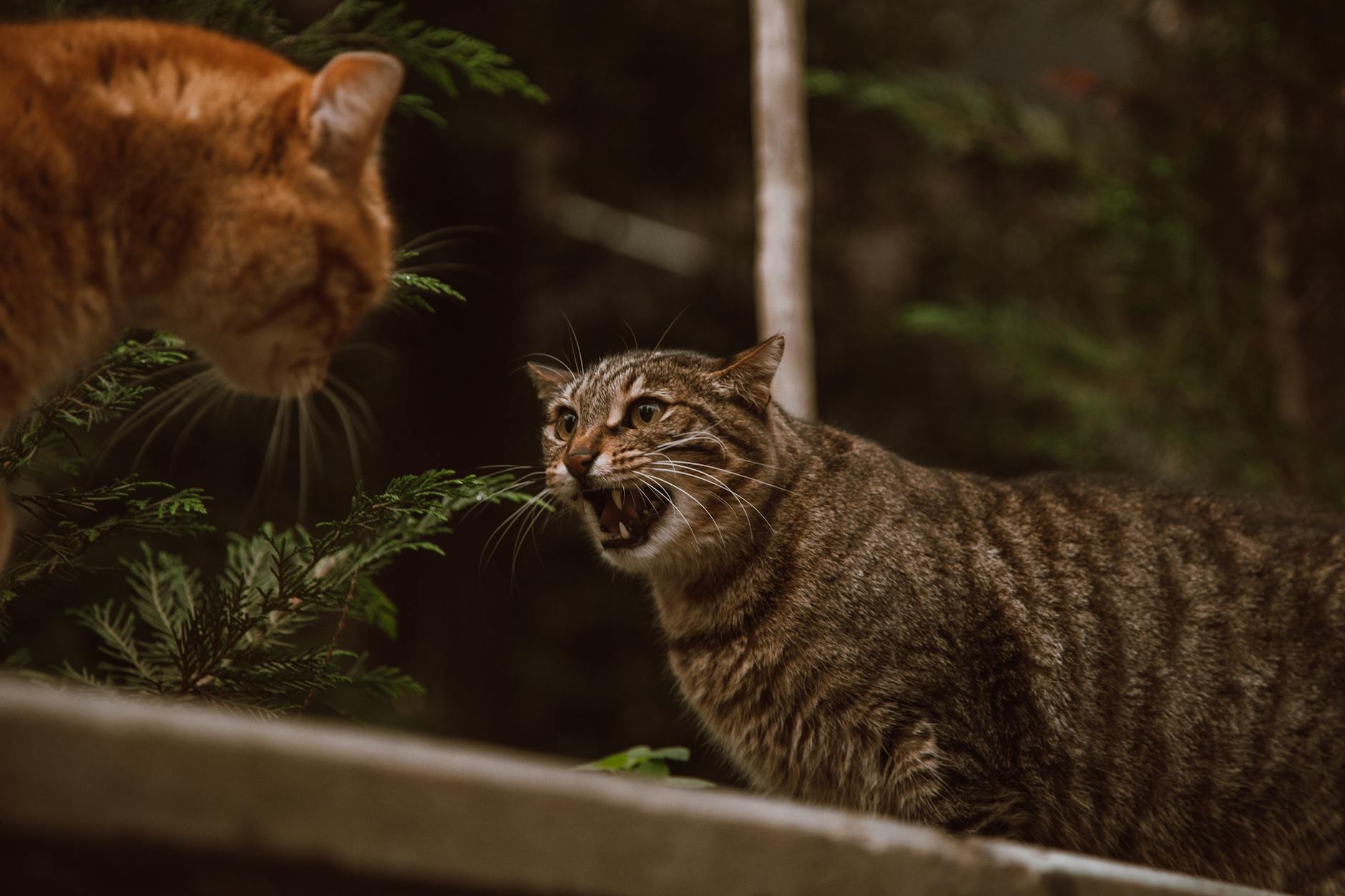
One of the first things any animal lover notices when they come to Thailand is the HUGE amount of cats.
With multiple cats on every soi, you might assume they are all friends. But let me assure you, that is not the case.
From my experience, Thai cats are very territorial, more so than most Western kitties.
Why is this? And what can we do to manage territorial aggression in our Thai cats?
Read on to find out!
Article content:
(Click any link to jump directly to the section)
Why Are Thai Cats So Territorial?
Cats are a naturally territorial species. But in my opinion, Thai cats are more territorial than Western domesticated kitties. Here’s why…
Their Feral Heritage
Let’s compare Thai cats with European or American cats for a moment.
In Western countries, there is a long lineage of cat breeding and domestication. Even if you adopt a kitty rather than buy from a breeder, it’s likely it was raised in a home around humans.
Thai cats, however, are mostly all born on the streets.
How does this affect their territorial nature?
Western felines essentially have a longer domesticated lineage than Thai cats. Thai cats are often descendants of either friendly strays or untamed feral cats, both of which, live on the street.
Feral cats are known to be significantly more territorial than domesticated cats.
So, if you were to adopt a kitten born from a feral cat, this kitten would likely have more wild instincts.
Moreover, some Thai cats descend from Siamese cats, one of the most territorial cat breeds worldwide.
High Stray Cat Population In Thailand

Another reason cats in Thailand can be so territorial is the high stray cat population.
If you live in a Thai neighborhood, you probably have stray cats hanging outside your door or gate. While you might like being greeted by kitties every time you go out, your cat certainly doesn’t.
Cats become territorial when they feel their home (territory) is under attack.
So, if your indoor cat sees strays hanging around, it can become insecure and believe the strays are trying to steal its home.
Or let’s say your pet cat likes to spend time in your garden during the day. If one morning, they go outside and smell the scent of another cat in the garden, this can make them highly anxious and stressed.
With so many stray cats in Thailand, this happens very often. Cats get used to other felines encroaching on their territory, which can lead to a more aggressive personality.
Moreover, many stray cats in Thailand are unsterilized. Research shows territorial aggression is more common in unsterilized cats than those that are neutered.
In the next section, I’ll explain how territorial aggression appears in a cat.
Understanding Feline Territorial Behavior

Before humans domesticated cats, felines were self-sufficient, hunting their own food.
Although pet cats might not have to hunt for food, they still view their world in the same way as wild cats.
Both wild and house cats typically have three different territories:
- Core territory – This is where they sleep and spend most of their time and is the most vigorously defended territory. For indoor/outdoor cats, this could be inside the house.
- Hunting territory – This is where they hunt. For indoor/outdoor cats, this might be the garden or the immediate area outside the house.
- Shared territory—This is a larger, shared area that a cat accesses on a time-share basis through a sophisticated social communication system.
Now, imagine what it feels like for a wild cat to find another feline in its hunting territory. They fear the other cat will steal all their food sources, causing them to starve and die. So, protecting their territory can be a life-or-death situation for wild cats.
Although pet cats don’t have the threat of starvation, they react the same way as a wild cat would. When a cat feels their territory is vulnerable or under attack, they might display the following signs:
- Spraying urine on walls or furniture
- Pacing
- Increased meowing or howling
- Trying to get outside (if an indoor cat)
- Hissing or growling at outdoor cats they see or smell
- Chasing cats away or getting into physical fights
Territorial Marking

One of the most common territorial behaviors in a cat is territorial marking.
Territorial marking refers to a cat putting its scent down to mark its territory. They might do this by scratching objects, rubbing themselves on something, or spraying urine.
Urine spraying (see photo above) differs from inappropriate peeing (peeing outside the litter box). It’s when a cat sprays small amounts of urine, usually on a vertical surface such as a wall, tree, or your curtains!
Why do they do this?
A cat’s urine scent is very strong, so it serves as an effective way to mark territory. When cats spray, they claim or reaffirm their territory, sending a message to other cats to stay away.
Are Thai Cats Friendly To Humans?

While Thai cats can be territorial and aggressive towards other cats, they are not aggressive to humans.
So don’t worry if you accidentally enter a stray cat’s territory. They won’t hiss at you or try to attack.
Cats don’t see humans in their territory as a threat. If they are well-socialised, they might welcome you, hoping you come bearing treats.
Or if they are feral, they will just run and hide. Typically, feral cats only show aggression toward humans if they feel cornered and trapped.
However, there is one type of cat-to-human aggression you should be aware of – Redirected aggression.
Redirected aggression happens when a cat gets triggered by an unfamiliar cat in its territory, but they cannot get to it.
Here’s an example….
Let’s say your cat is sleeping peacefully indoors by a window. Suddenly, it wakes up to see an unfamiliar stray cat in the garden. It tries to go out and defend its territory, but the windows and doors are closed, stopping it.
Now, if you were to pick up or pet your cat at this moment, they might redirect their aggression toward you by biting or scratching you.
It’s important to note that they do not do this intentionally. The sight or smell of another cat stresses them out, and because they cannot respond directly, they redirect their anger to you.
Cats can also redirect their anger to another cat in the household.
How To Reduce Territorial Aggression In Thai Cats

Dealing with territorial aggression in Thai cats can be extremely frustrating. Often it becomes the case of this…
If you let them outside, they keep getting into cat flights. But if you keep them inside, they start pacing, howling, and spraying on your furniture!
So what can you do if you have a highly territorial cat like this?
From my research, I’ve found that territorial aggression comes from territorial insecurity.
The more insecure a cat feels in their home, the more territorial they will become.
So to reduce territorial aggression, focus on making them feel as secure as possible.
Here are some ways to do so:
- Sterilize them – Sterilization significantly reduces territorial aggression in cats. If your cat is not yet neutered, arrange this with your vet ASAP. Plus, if the stray cats on your soi are unowned, consider sterilizing them as this will reduce the likelihood of them entering your garden and picking fights with your cat.
- Establish a routine – Cats thrive on routine and familarity. When a cat knows what to expect from their day and the times they will eat, they feel calm and content.
- Schedule daily play sessions – Playing with your cat is a great way to release any pent-up energy they may have, which otherwise they might direct towards another cat.
- Cat-proof your garden – Although this won’t be an option for everyone, cat-proofing my garden significantly reduced my cats territorial behavior. By preventing stray cats from entering your garden, you create a safe and secure outdoor area for your kitties.
- “Catify” your house – Make your cat’s core territory (your home) more enriching by adding cat trees, cat shelves, and high-up perching spots. Cat behaviorist Jackson Galaxy has many awesome tips on catifying your home.
- Use cat calming products – Things like Feliway, pet CBD oil, and calming supplements may help to reduce territorial stress and anxiety in cats. For more information on these, read my guide on the Best Cat Calming Products In Thailand.
Final Thoughts On Territorial Aggression In Thai Cats
The high stray population in Thailand, coupled with their wild ancestry, can make Thai cats highly territorial.
For a species that naturally prefers solitude, the stress of living near many other felines can be overwhelming.
If your Thai cat displays signs of territorial aggression, consider applying some of the tips and products mentioned above.
In my experience, when you take steps to help your cat feel more secure, they become calmer, more content, and less bothered by the presence of other cats.
Leave a Reply